 Golden hour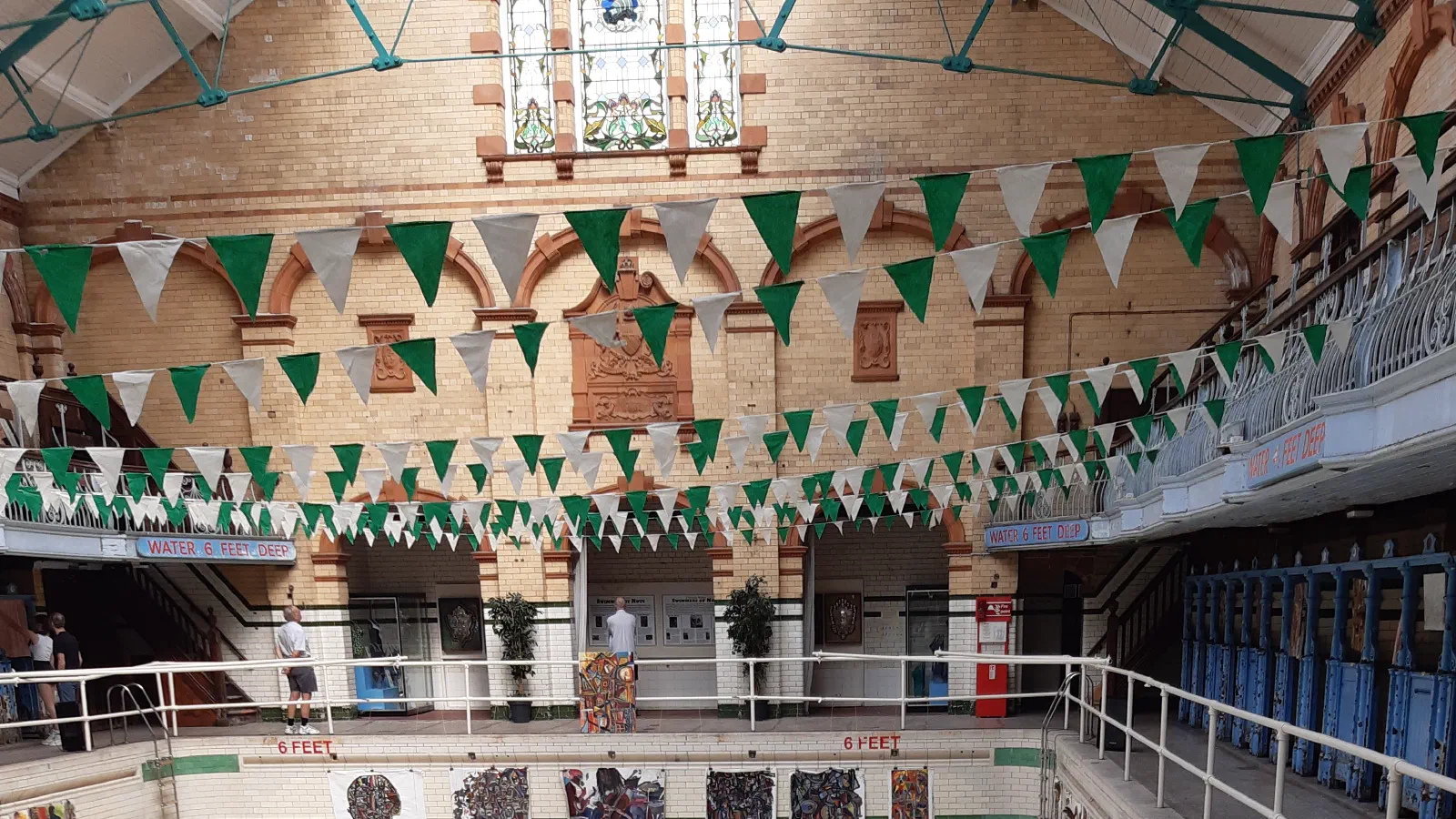
Best at any / overcast
Victoria Baths
South Manchester · Manchester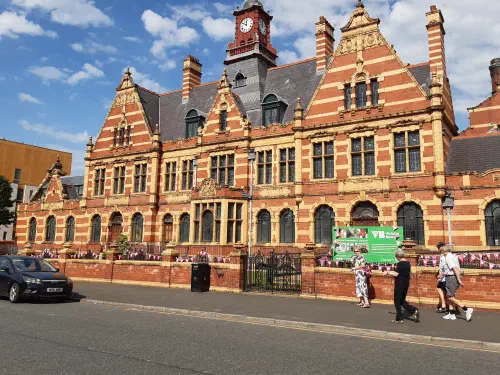
Some gear links on this page are affiliate links — if you buy through them we may earn a small commission at no extra cost to you. See our affiliate disclosure.
What is Victoria Baths?
Victoria Baths, often dubbed the “water palace,” is a Grade II* listed Edwardian public baths complex in Manchester’s Chorlton-on-Medlock, completed in 1906 at a cost of £59,144. Designed by T. de Courcy Meade (City Surveyor), assisted by Arthur Davies, and overseen by City Architect Henry Price, the building is constructed from ornate brick and terracotta, with lavish Art Nouveau interiors, extensive glazed tiling, floor mosaics, and over 100 stained glass windows.
The facility originally included three swimming pools (for 1st-class males, 2nd-class males, and females), Turkish and Russian baths, private bath cubicles, and later, in 1952, the UK’s first public Aeratone whirlpool. It served the community until 1993, after which it fell into disrepair until restoration efforts began following a 2003 win on BBC’s Restoration—receiving a £3.4 million Heritage Lottery grant. Since then, the building has hosted open days, guided tours, and special events amid partial restoration.
Why Shoot Here?
Victoria Baths offers an unmatched blend of visual drama, historic elegance, and evocative decay—perfect for photographers and Instagrammers:
- Ornate detail: From richly tiled walls and mosaic floors to stained glass windows and decorative terraces, the textures are exquisite and unique.
- Lighting and ambience: The vaulted skylights create beautiful diffused natural light; evening events add warm atmospheric tones and mood.
- Historic storytelling: Capture the paradox of grandeur and abandonment—the echo of a bygone era, preserved in faded elegance.
Getting There
There is no tram. The 53 or 197 bus from Piccadilly Gardens takes about ten minutes, and it is roughly a fifteen-minute walk from Manchester Piccadilly. There is free street parking on Hathersage Road, which is the easy option if you are driving. The building is in Chorlton-on-Medlock, on the edge of south Manchester.
Access is the whole planning problem here, and it is worth being blunt: Victoria Baths is not open to walk into. It opens for events, open days and guided tours only, and you need to check the schedule and usually book. The building has been partly restored since its 2003 Restoration win, but it is not a functioning attraction with daily opening hours. Plan the trip around a published date rather than the weather. Whitworth Art Gallery and Platt Fields Park are both nearby if you want to build a half-day around it.
Photography FAQ
Can you take photos inside Victoria Baths?
On open days and tours, yes — photography is a large part of why people come, and the building is well used to it. What varies is the detail: whether tripods are allowed, which areas are accessible on that particular date, and whether a specific event has its own restrictions. Check when you book. Some rooms remain unrestored and closed off entirely, so what you can reach differs between visits.
When is it open?
Open days, guided tours and events only, mostly spring through autumn, with the schedule published by the baths themselves. Guided tours are the better option for photographers: they reach otherwise restricted areas and move at a pace that lets you actually work, whereas an open day gives you freedom of movement but crowds in every frame. Evening events are the third category, and a completely different look.
What is the best light inside?
Midday on an overcast day. The vaulted skylights over the pool halls flood the space with soft diffused daylight, which is the condition the interior was designed around — bright sun through the same glass throws hard patches and the tiled side rooms fall away to black. Away from the skylights it gets dark fast, and tripods are impractical in open-day crowds, so a fast prime and a willingness to push ISO is what keeps you shooting.
What should I photograph here?
The three empty pools, shot from the shallow end toward the deep end so the pool edges and balcony railings frame symmetrically. The decorative work close up — glazed tiles, mosaic floors, Art Nouveau fixtures. The stained glass, of which there are over a hundred windows, exposed for the glass so the colour glows against a dark interior. And the decay: peeling paint and faded surfaces make a backdrop for portraits that no studio set can fake.
What was Victoria Baths?
A Grade II* listed Edwardian public baths complex, completed in 1906 and known as the “water palace” — three swimming pools separated by class and sex, Turkish and Russian baths, private cubicles, and from 1952 the UK’s first public Aeratone whirlpool. It served the community until 1993 and then decayed until a 2003 win on BBC’s Restoration brought a £3.4 million Heritage Lottery grant. That arc is the subject: this is grandeur and abandonment in the same frame, which is why it photographs unlike anything else in the city.
Further Information
- Wikipedia – Victoria Baths — architecture, history, closure, and restoration efforts
- Historic Pools website – Victoria Baths — architectural details, decorative features, current status
- Victoria Baths official site – History & Interior Gallery — guided tours, events, and in-depth visuals
Best Times to Shoot
- Midday on open days: The vaulted skylights flood the pool halls with soft, diffused natural light — the best conditions for interior photography. Away from the skylights the tiled side rooms drop dark fast, and tripods are impractical among open-day crowds, so a fast 35mm f/1.8 — the Sony FE 35mm f/1.8 , Canon RF 35mm f/1.8 Macro IS STM , NIKKOR Z 35mm f/1.8 S , or the Fujifilm XF 23mm f/2 R WR on Fujifilm X — is what keeps you shooting handheld.
- Guided tours (spring through autumn): These provide access to otherwise restricted areas and let you shoot at a more relaxed pace.
- Event nights: Evening events with artificial and atmospheric lighting create dramatic, moody conditions for long exposures and portraits.
- Overcast days: Bright but diffused daylight through the glass roof avoids harsh shadows and keeps detail visible in both highlights and tiles.
Composition Ideas
- Stand at the shallow end of an empty pool and shoot toward the deep end, using the pool edges and balcony railings as symmetrical framing lines.
- Focus on close-up details of the glazed tiles, mosaic floors and Art Nouveau fixtures to capture the richness of the decorative work.
- Photograph the stained glass windows from inside, exposing for the glass to make the colours glow against the darker interior.
- Use the peeling paint and faded surfaces as a textured backdrop for moody portraits that contrast human presence with architectural decay.
How to shoot it
Lens
A 16–35mm wide captures the full space; bring a fast prime (f/1.8) for the dim corners without a tripod.
Settings
Tripod where allowed, f/8 and low ISO; otherwise a fast prime wide open. Bracket exposures to hold both windows and shadows.
Composition
Centre on symmetry, get low for soaring ceilings, and let leading lines pull the eye down the room.
Timing
Bright overcast suits it best — soft, even light with no harsh shadows — so it works at almost any time of day.
More in South Manchester
See the area →