 Golden hour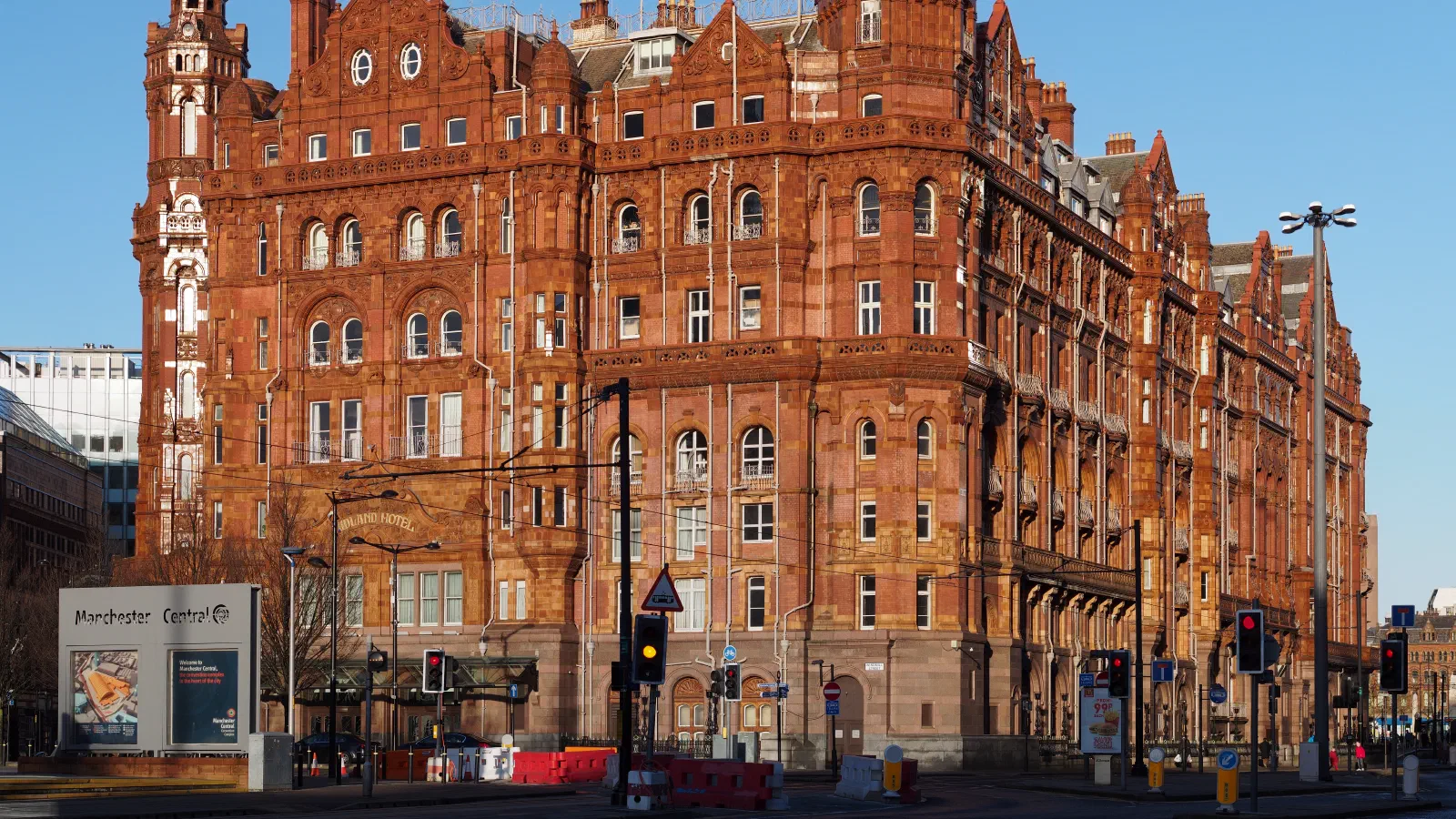
Best at golden hour
The Midland Hotel
Petersfield · ManchesterSome gear links on this page are affiliate links — if you buy through them we may earn a small commission at no extra cost to you. See our affiliate disclosure.
What is The Midland Hotel?
The Midland Hotel is one of Manchester’s most famous and grand hotels. Opened in 1903 by the Midland Railway, it is a magnificent example of Edwardian Baroque architecture, built with red brick and brown terracotta.
Why Shoot Here?
- Edwardian Grandeur: The hotel’s exterior is incredibly detailed, with ornate terracotta carvings and a grand presence that dominates the street corner.
- Historic Significance: It’s where Mr. Rolls met Mr. Royce, making it a spot of great historical interest as well as beauty.
- Luxurious Interiors: The lobby and public bars offer a glimpse into a bygone era of luxury, with marble floors, grand staircases, and ornate ceilings.
- Street View Perspectives: The hotel’s location at the junction of several major streets provides numerous angles for capturing its imposing scale within the city centre.
Getting There
St Peter’s Square Metrolink is a one-minute walk and Manchester Oxford Road station is about five, which makes this one of the most easily reached spots in the city. NCP Great Northern is the nearest car park at roughly £8–12 per day. The hotel occupies a full block between Peter Street, Lower Mosley Street and Windmill Street, so there is level pavement on every side and no shortage of room to step back.
The exterior is public street and photographable at any hour. The lobby, the grand staircase and the public bars are accessible to visitors, though it is a working hotel rather than an attraction. St Peter’s Square is directly opposite and Central Library a minute beyond it, both in Petersfield — the city centre squares and neon walk starts a minute away at the library.
Photography FAQ
Can you photograph inside The Midland Hotel?
The public areas — the lobby, the grand staircase and the bars — are open to visitors, and handheld photography there is generally accepted. It remains a working hotel, so exercise discretion: keep guests out of frame, don’t photograph anyone at the reception desk, and buy a drink if you are going to spend time in the bar. Anything more involved than a handheld camera, a tripod especially, is worth clearing at reception first rather than assuming.
What is the best time to photograph The Midland Hotel?
Late afternoon golden hour for the exterior. The south-facing Peter Street facade takes warm light from about 13:00 in winter to 18:00 in summer, and low sun turns the red brick and brown terracotta a deep, saturated tone while the carved ornament casts short shadows that reveal its relief. Blue hour from across St Peter’s Square is the other strong option — ground-level uplighters and window lighting give the facade a layered glow against a darkening sky. For interiors, weekday mornings before 10:00 are quietest.
Where do you stand to get the whole building in?
The north pavement of Peter Street, with a 24–35mm. The hotel occupies an entire block, and getting both corner turrets into one frame needs the width. Adding a passing pedestrian or a taxi at the front entrance gives the Edwardian scale something human to measure against. For a wider civic composition, move into St Peter’s Square and shoot at 35–70mm with the modern glass towers on either side — the hundred-year gap in one frame.
What lens do I need for the terracotta detail?
A 70–200mm from across the street. The Edwardian Baroque terracotta was made to a high specification, and the panels in the spandrels between windows and the cartouches above the main entrance carry figurative and geometric ornament that is invisible at street level and completely lost in a wide shot. Raking late-afternoon light is what makes the carving read.
Why is The Midland Hotel historically significant?
It opened in 1903, built by the Midland Railway to serve the adjacent Central Station, and it is where Charles Rolls met Henry Royce — the meeting that led to Rolls-Royce. For photographers the relevant point is the budget that history implies: the building was made to impress arriving rail passengers, and the density of ornament in the brick and terracotta reflects that intention rather than any structural necessity.
Best Times to Shoot
- Late afternoon golden hour — The Midland Hotel’s south-facing facade on Peter Street and the adjacent corner toward St Peter’s Square receive warm afternoon light from around 13:00 in winter to 18:00 in summer. The red brick and brown terracotta go a deep, saturated tone in low sun, and the carved ornamental details — the terracotta panels, the corner turrets — cast short, revealing shadows. This is the single best window for the exterior photograph.
- Blue hour from across St Peter’s Square — Walk to the opposite side of St Peter’s Square and shoot the Midland Hotel at blue hour when its illuminated facade glows warmly against the darkening sky. The hotel is lit from ground-level uplighters and from its window lighting, giving a multilayered glow. The Central Library is visible to the right, creating an Edwardian-and-interwar civic grouping in a single shot.
- Weekday mornings for interior access — The lobby, grand staircase, and public bar of The Midland are at their quietest before 10:00 on weekday mornings. This is the practical window for interior photography without having to navigate around hotel guests or restaurant service. The morning light through the east-facing lobby windows adds natural illumination to the marble surfaces.
- After rain for pavement reflections — The pavement on Peter Street outside The Midland is wide and smooth. After rain, the entire lower section of the terracotta facade and any illuminated signage reflects clearly in the wet stone. A 24–35 mm lens from pavement level gives both the reflected building below and the real building above in the same frame.
Composition Ideas
- Full facade from across the street — Stand on the north pavement of Peter Street and use a 24–35 mm lens to capture the full width of the Midland Hotel facade. The building occupies a full city block; stepping back far enough to include the corner turrets at both ends requires a wider lens. Include passing pedestrians or a taxi at the front entrance to give the Edwardian scale a human reference.
- Terracotta detail close-ups — Use a telephoto like the Sony 70-200mm f/4 G OSS from across the street to isolate individual terracotta panels in the spandrel sections between windows, or the ornamental cartouches above the main entrance. The Midland Hotel’s Edwardian Baroque terracotta was produced to a high specification and individual panels contain figurative and geometric ornament that rewards dedicated close-up attention.
- Grand staircase interior — Find a position on the mezzanine level looking down at the grand staircase or looking up from the base toward the ceiling. A 16–24 mm wide-angle captures the full sweep of the stair, the marble balustrade, and the ornate ceiling above in a single frame. Shoot when the lobby is quiet to avoid distracting crowd clutter.
- Old-meets-new from St Peter’s Square — Frame The Midland Hotel from the Square with the modern glass office towers of St Peter’s Square visible to either side. A 35–70 mm lens from the square’s central area captures the hotel’s terracotta turret above and the modern glass and steel of the adjacent buildings — the 100-year architectural gap visible in a single composition.
How to shoot it
Lens
A 16–35mm wide exaggerates scale and verticals; a 24–70mm keeps proportions natural. A tilt-shift tames converging lines.
Settings
f/8–f/11 for front-to-back sharpness, ISO 100, and meter for the highlights so detail in the stonework holds.
Composition
Hunt for symmetry and repetition, keep verticals straight, and use doorways or arches to frame the subject.
Timing
Aim for golden hour — the hour after sunrise or before sunset — when low, warm light rakes across the scene. Today's exact window is in the panel on this page.
More in Petersfield
See the area →