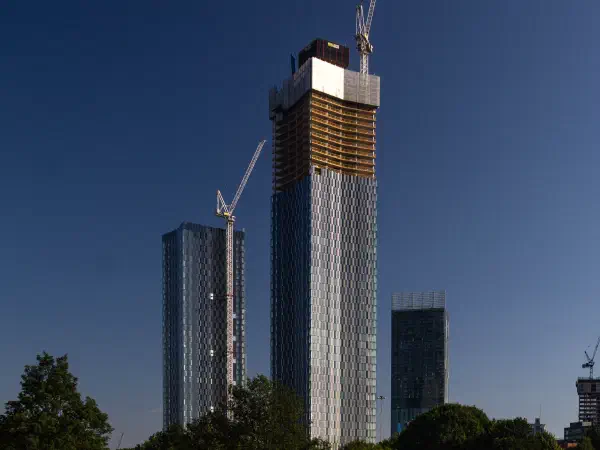
 Blue hour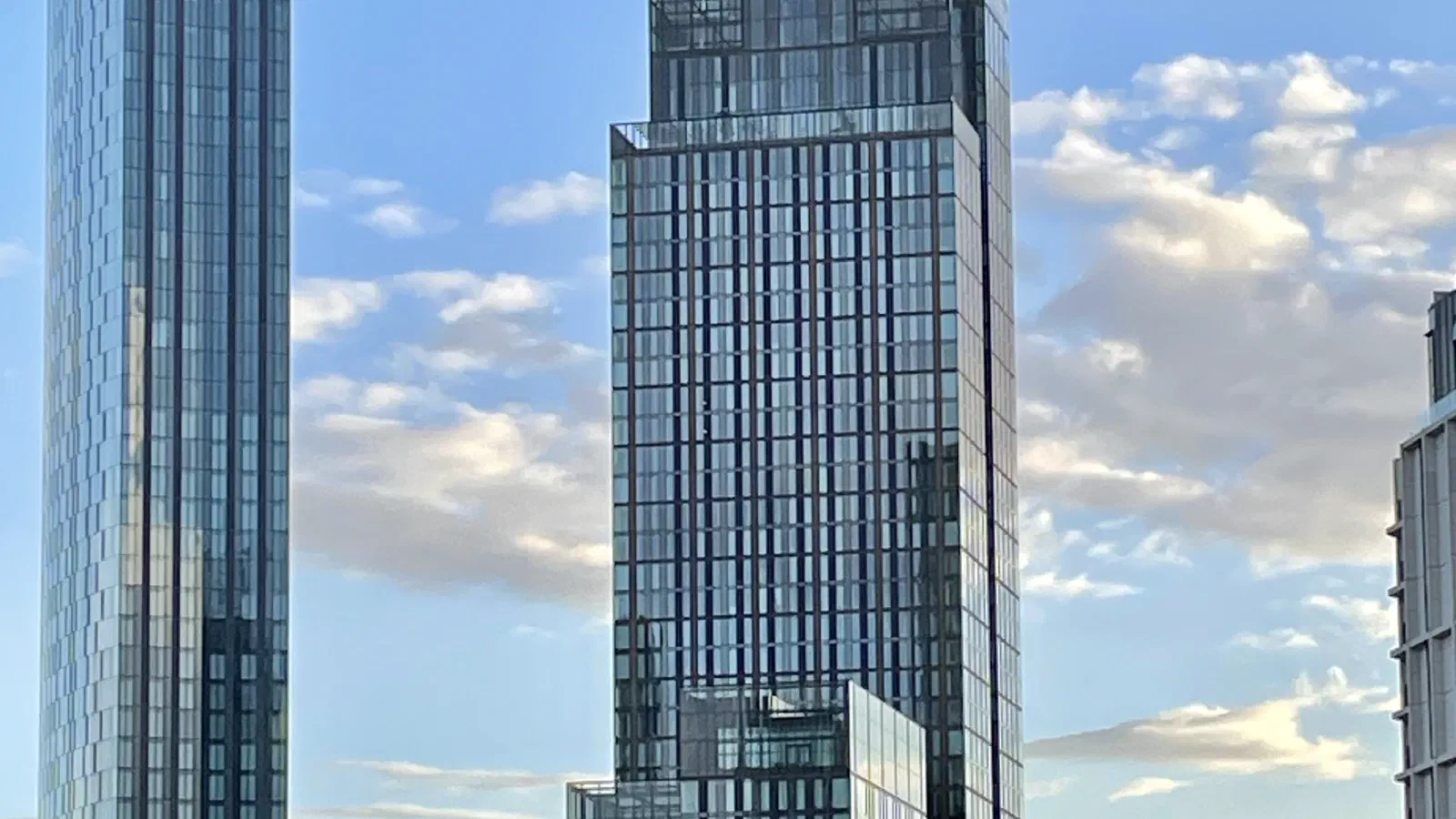
Best at golden hour
The Blade & Three60
New Jackson · ManchesterSome gear links on this page are affiliate links — if you buy through them we may earn a small commission at no extra cost to you. See our affiliate disclosure.
What are The Blade and Three60?
These are two of the newest additions to the New Jackson skyline. The Blade is known for its distinctive sharp-edged profile, while Three60 is Manchester’s first cylindrical skyscraper, offering a unique circular perspective to the city’s high-rise architecture.
Together, the two towers form one of the most visually striking pairings in Greater Manchester’s modern skyline. Set within the emerging New Jackson neighbourhood — a major regeneration area between Deansgate and the River Irwell — they are surrounded by new public realm, landscaping and pedestrian routes that frame them against both the historic city centre and the newer Salford developments across the water.
Why Shoot Here?
- Geometric Contrasts: The sharp, angular lines of The Blade contrasted with the smooth, circular form of Three60 provide a fascinating study in geometric architectural photography.
- Glass Textures: Both towers feature high-quality glass cladding that creates intricate reflection patterns, especially during the “golden hour.”
- Innovative Design: Capture the cylindrical form of Three60 from various angles to show how it changes the perception of space in the district.
- Modern Streetscape: The area around these towers is being developed with high-end landscaping, providing clean and modern foreground elements for your shots.
Getting There
Deansgate-Castlefield Metrolink is a five-minute walk and Deansgate rail station adjoins it. NCP Spinningfields is the nearest car park at roughly £8–12 per day. The towers stand in New Jackson, the regeneration area between Deansgate and the River Irwell, and like the rest of that skyline they are visible from a long way off — walk toward them.
The public realm around the base of both towers is open access at any hour and free, and it is where the shoot happens: both buildings are residential, so this is ground level only. New Jackson and the Deansgate Square towers are the immediate neighbours, with Castlefield Canals five minutes south for the wider contextual view back toward the cluster.
Photography FAQ
Can you photograph The Blade and Three60?
Yes — the public realm at the base is open access with no restriction on photography or tripods. Both towers are residential, so shoot the buildings rather than into individual apartments and balconies; lobbies are private. As with any managed development, someone may ask what you are doing if you are set up near an entrance, and a straight answer settles it.
What is the point of shooting these two together?
The geometry. The Blade has a hard, sharp-edged angular profile; Three60 is Manchester’s first cylindrical skyscraper. Setting one against the other is the whole subject, and it is a pairing you cannot find elsewhere in the city. Find a position on Owen Street where both fit at 35–50mm and compose so neither dominates — the contrast between the two forms should be the explicit content of the frame, not an incidental byproduct.
How do you photograph a cylindrical building?
By walking round it. Three60 reads completely differently from different compass points — from some angles it looks almost flat, from others the curvature is extreme — so shoot it from at least four positions and pick afterwards. A 35mm from 20–30 metres gives the most natural, undistorted reading of the form. In warm evening light the lit arc migrates around the circumference as the sun drops, which is a shifting highlight no flat-glazed building can produce.
What is the best time to shoot?
Golden hour, when the west-facing glass on both towers goes amber in the last half hour — shoot from the eastern side of Owen Street. Blue hour is the better one for the geometric contrast, when both forms stay legible and interior lights balance the ambient sky. Clear days with fast-moving cumulus are the wildcard: Three60’s curved facade wraps reflected cloud around its circumference, changing every few seconds, and it rewards standing still and waiting.
What lens should I bring?
A 35–50mm for the two towers together and for the walk-around views of Three60. A 16–24mm for the upward shot at the base of The Blade, where the angular cladding and sharp corner geometry converge at the top of the frame against clean sky. Keep the same wide lens for the public realm foregrounds — from 50–60cm off the ground, the clean-edged planting beds and flush-lit paving give you a human-scale foreground against the towers’ height, and after rain those same polished surfaces give you puddle reflections.
Best Times to Shoot
- Golden hour (late afternoon, west-facing) — The glass cladding on both The Blade and Three60 faces multiple directions, but the west-facing sections turn amber and orange in the final 30 minutes before sunset. Three60’s cylindrical form is particularly interesting in warm evening light: as the sun drops, the lit arc of the cylinder migrates across the building’s circumference, creating a constantly shifting highlight pattern. Shoot from the eastern side of Owen Street for the best angle on this effect.
- Blue hour — Both towers illuminate from within as residents return in the evenings. The Blade’s sharper, angular edges and Three60’s smooth curve are both legible in blue-hour conditions, and the contrast between the two forms is most apparent at this time when artificial and ambient light are balanced — tripod territory (something like the Peak Design Travel Tripod travels well), and worth reading our blue hour tripod guide first: these towers funnel wind through the exact corners with the best sightlines. The new New Jackson public realm has good sightlines to both towers from the south.
- After rain — The polished stone and smooth concrete of the Owen Street public realm create high-quality puddle reflections after rain. Both towers reflect cleanly in larger puddles, and the distortion created by uneven pavement surfaces around the puddle edges adds a useful quality to the abstract reflection composition.
- Clear days with moving cloud — Three60’s circular glass facade reflects cloud movement dynamically as clouds cross the sky. The curved surface wraps the reflected clouds around the building’s circumference in a way that no flat-glazed building can. On a day with fast-moving cumulus, the reflection changes every few seconds and rewards patience with a sequence of different cloud-wrapped images.
Composition Ideas
- Both towers together from Owen Street — Find a position on Owen Street where both The Blade and Three60 are visible in the same frame with a 35–50 mm lens. The juxtaposition of The Blade’s hard-edged angular profile against Three60’s smooth curve is the primary subject; compose so neither building dominates and the contrast between the two forms is the explicit content of the image.
- Walking-around Three60 — Photograph Three60 from at least four compass points: each position reveals a different proportion of the curved surface and a different skyline or street context behind it. From some angles the building appears almost flat; from others, the curvature is extreme. A 35 mm lens from 20–30 metres gives the most natural, undistorted reading of the building’s form.
- Upward from the base of The Blade — Stand at the base of The Blade on the public realm and aim a 16–24 mm ultra-wide directly up the building’s facade. The angular cladding and the sharp corner geometry of the building create converging vertical lines that meet at the top of the frame; on a clear day the blue sky provides a clean backdrop.
- Public realm as compositional foreground — The landscaped ground plane around both towers includes clean-edged planting beds, flush-lit paving, and minimal street furniture. Use a 24–35 mm lens from a low angle — 50–60 cm — to include the paving pattern or planted bed in the foreground with the towers rising behind. The contrast between the human-scale design elements and the towers’ height is a consistent device for these New Jackson buildings.
How to shoot it
Lens
Reach for a 70–200mm to compress the towers and stack the skyline; a 24–70mm covers wider establishing frames.
Settings
Tripod, f/8–f/11, ISO 100 and exposures of 1–10s to balance lit windows against the sky.
Composition
Find a clean foreground or reflective surface, place the tallest tower off-centre on a third, and layer near and far elements.
Timing
Aim for golden hour — the hour after sunrise or before sunset — when low, warm light rakes across the scene. Today's exact window is in the panel on this page.
More in New Jackson
See the area →Nearby spots
Blue hour Blue hour