 Any / overcast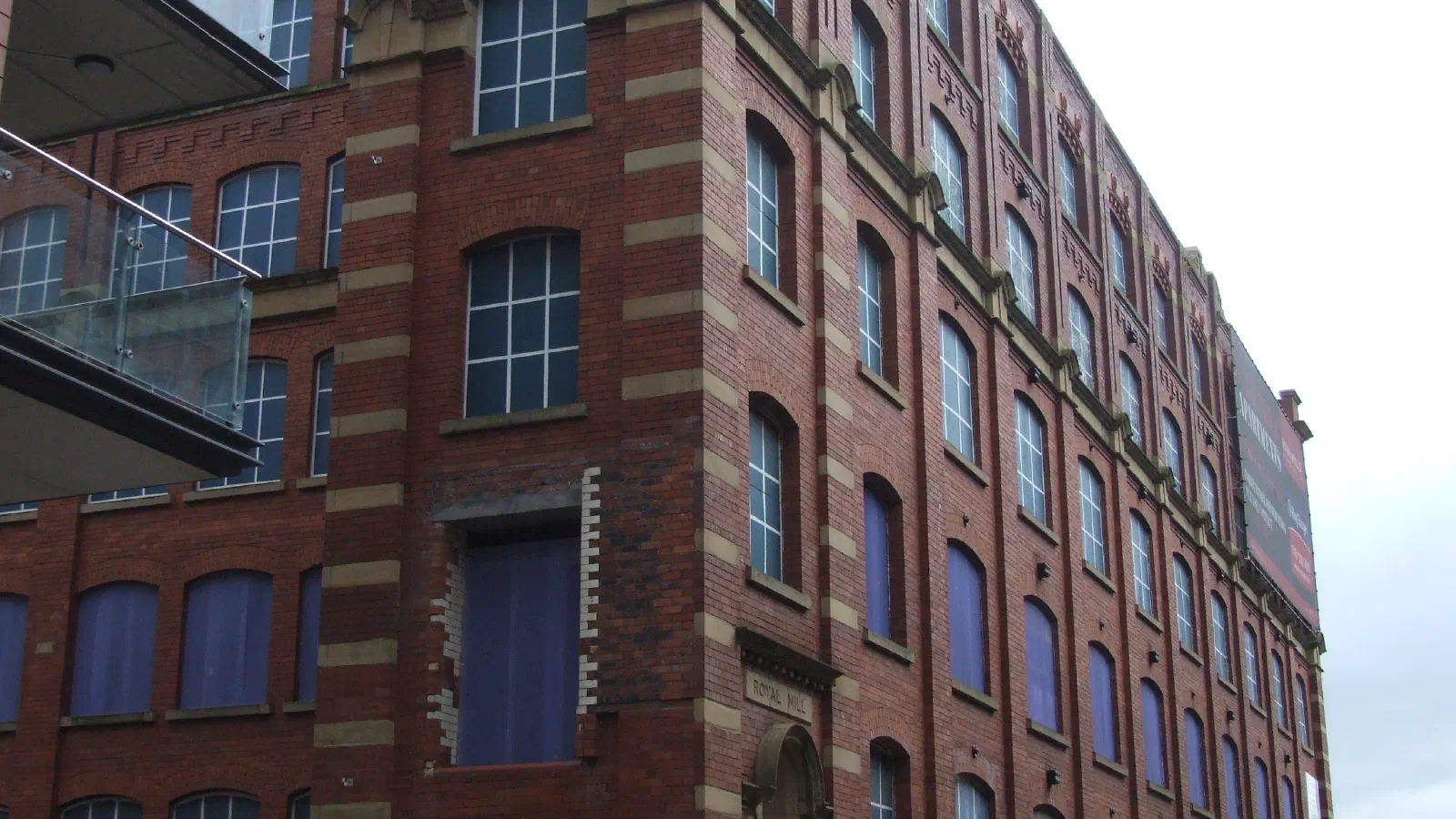
Best at golden hour
Royal Mill
Ancoats · ManchesterSome gear links on this page are affiliate links — if you buy through them we may earn a small commission at no extra cost to you. See our affiliate disclosure.
What is Royal Mill?
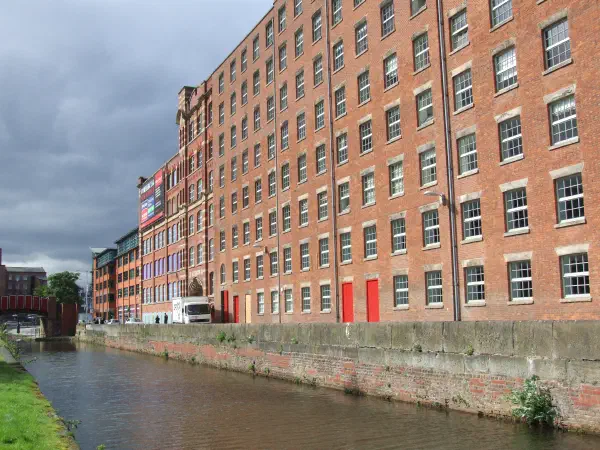
Royal Mill is one of the most imposing and architecturally significant mills in Ancoats. Built in 1912 on the site of an earlier mill, it was named in honor of a visit by King George V and Queen Mary. The mill is a Grade II* listed building and features a massive brick chimney and a grand entrance on Redhill Street. It has since been converted into luxury apartments.
Why Shoot Here?
- Industrial Grandeur: The sheer scale of the mill, especially viewed from Redhill Street, captures the massive industrial power of 20th-century Manchester.
- Rochdale Canal Reflections: The mill sits directly on the Rochdale Canal. On calm days, the water provides a perfect mirror for the mill’s towering brick facade and historic windows. If the surface is choppy, a 6-stop ND at 1–4 seconds flattens it — and be careful with a polariser here, which can erase the reflection entirely. Our canal filters guide covers which way to rotate it.
- Architectural Details: From the ornate lettering above the entrance to the massive chimney and the iron-framed windows, there are endless details for architectural photographers.
- Blue Hour: As the city lights come on, the red brick and the canal water create a moody and atmospheric industrial scene.
Getting There
New Islington Metrolink is a five-minute walk and Manchester Piccadilly about twelve. NCP Ancoats is the nearest car park at roughly £6–10 per day. The mill fronts Redhill Street along the Rochdale Canal in Ancoats, and the towpath opposite is where most of the photography happens — reachable at canal level, flat once you are on it.
Royal Mill is now residential. The exterior and the main courtyard during business hours are accessible, but the building is people’s homes behind the facade you are pointing a lens at, and that shapes where you stand and how long you linger. Shoot the architecture, not the windows. Murrays’ Mills is directly adjacent, Cutting Room Square five minutes west and Anita Street a couple of minutes north — the Ancoats mills and marina loop covers all of them.
Photography FAQ
Can you photograph Royal Mill?
The exterior from Redhill Street and from the Rochdale Canal towpath, freely — both are public and there is no restriction on tripods. The main courtyard is accessible during business hours. What needs judgement is the residential conversion: the illuminated windows that make the blue hour shot so good are individual flats, so frame the facade as a facade and keep a long lens off any single window. The courtyard is a shared residential space, not a public square — be brief and unobtrusive.
What is the definitive shot here?
Blue hour from the canal towpath opposite, 20–40 minutes after sunset. The converted apartment windows light up from within as people get home, appearing as horizontal rows across the brick, and the canal turns those into vertical columns of reflection below. A tripod is essential and it must be dead level — the slightest tilt skews the reflection and the whole image falls apart. Place the waterline through the horizontal centre of the frame at 35–50mm.
What if the canal surface is choppy?
A 6-stop ND at 1–4 seconds flattens it into a usable mirror. Be careful with a polariser, though: rotated the wrong way it will kill the reflection you came for entirely, which on this particular subject is the difference between the shot and no shot. Still mornings at dawn are the alternative — the basin behind the mill is at its calmest before any boat traffic, and in autumn and winter first light catches the upper facade while the water below is still in shade.
When is the best light on the Redhill Street side?
Late afternoon. That facade faces roughly west-south-west and takes warm directional light from about 15:30 in autumn through to 19:00 in summer, which is when the ornate entrance lettering and the proportioned window grid read best in raking low light. Overcast midday is the opposite choice and just as valid: even light shows the full scale of the window grid across the whole facade and renders the brick colour accurately rather than pushing it orange.
What lens should I bring?
A 35–50mm for the full facade-and-reflection frame from the towpath. A 24–35mm for the towpath leading-line shot, using the canal edge to draw the eye toward the mill. An 85–100mm from across Redhill Street to isolate the “Royal Mill” lettering and the ornament above the entrance — unusually fine work for an industrial building, and the detail that separates this from a utilitarian mill. There is nothing here that needs longer.
Best Times to Shoot
- Blue hour (20–40 minutes after sunset) — The converted residential windows in Royal Mill illuminate from within as occupants arrive home in the evening. From the Rochdale Canal towpath opposite, the warm apartment lights appear as horizontal rows across the brick facade and their reflections create vertical columns in the canal water. This is the definitive Royal Mill shot; a tripod is essential — something like the Peak Design Travel Tripod keeps the camera dead level for the reflection — and the canal water needs to be still.
- Late afternoon (golden hour on the Redhill Street side) — The Redhill Street facade faces roughly west-south-west and receives warm directional light from about 15:30 in autumn through to 19:00 in summer. The Grade II* listed building’s ornate entrance lettering and the proportioned window pattern are most readable in this raking, low-angle light.
- Still mornings at dawn — The Rochdale Canal basin runs behind Royal Mill and is at its calmest before any boat traffic arrives. In autumn and winter, the first light hits the upper portions of the mill facade while the canal is still in shade, creating a dramatic contrast between the lit brick above and the reflective dark water below.
- Overcast midday — The mill’s sheer scale — it is one of the largest brick structures in Ancoats — is best appreciated in even light that reveals the window grid pattern across the full facade without shadowing the lower sections. Overcast conditions also make the brick colour more accurate and less orange than in warm afternoon light.
Composition Ideas
- Full facade from the Rochdale Canal towpath — Stand on the north bank of the Rochdale Canal opposite Royal Mill and use a 35–50 mm lens to frame the full mill facade above and its reflection below. Place the waterline at the horizontal centre of the frame for a symmetrical composition. A tripod set at canal-bank height keeps the camera level; the slightest camera tilt produces a skewed reflection.
- Ornate entrance lettering close-up — The “Royal Mill” lettering above the Redhill Street entrance and the surrounding architectural ornament are finely executed for an industrial building. Use an 85–100 mm lens from across the street to isolate the lettering and brickwork above it, filling the frame with the heritage detail that distinguishes this from a utilitarian structure.
- Canal towpath leading line toward the mill — Walk the towpath until Royal Mill is in the mid-ground and the canal stretches away from you in the foreground. A 24–35 mm lens uses the towpath edge and canal surface as converging lines that draw the eye toward the mill. Include the water’s reflection of the brickwork to add visual complexity to the foreground.
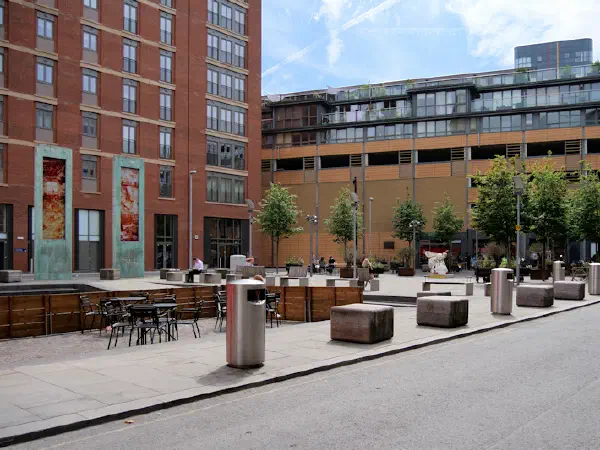
- Combined story with Cutting Room Square — Walk from the canal towpath around to Cutting Room Square and shoot back toward Royal Mill with the square’s bar seating and modern social life in the foreground. This two-part sequence — mill-and-canal, then mill-and-social-scene — tells the story of Ancoats’ transformation from industrial to mixed-use neighbourhood.
How to shoot it
Lens
A 16–35mm wide exaggerates scale and verticals; a 24–70mm keeps proportions natural. A tilt-shift tames converging lines.
Settings
f/8–f/11 for front-to-back sharpness, ISO 100, and meter for the highlights so detail in the stonework holds.
Composition
Hunt for symmetry and repetition, keep verticals straight, and use doorways or arches to frame the subject.
Timing
Aim for golden hour — the hour after sunrise or before sunset — when low, warm light rakes across the scene. Today's exact window is in the panel on this page.
More in Ancoats
See the area →Nearby spots
Shooting the whole area? Read the Ancoats photography guide — every spot, the light that suits it, and a route to link them.