 Any / overcast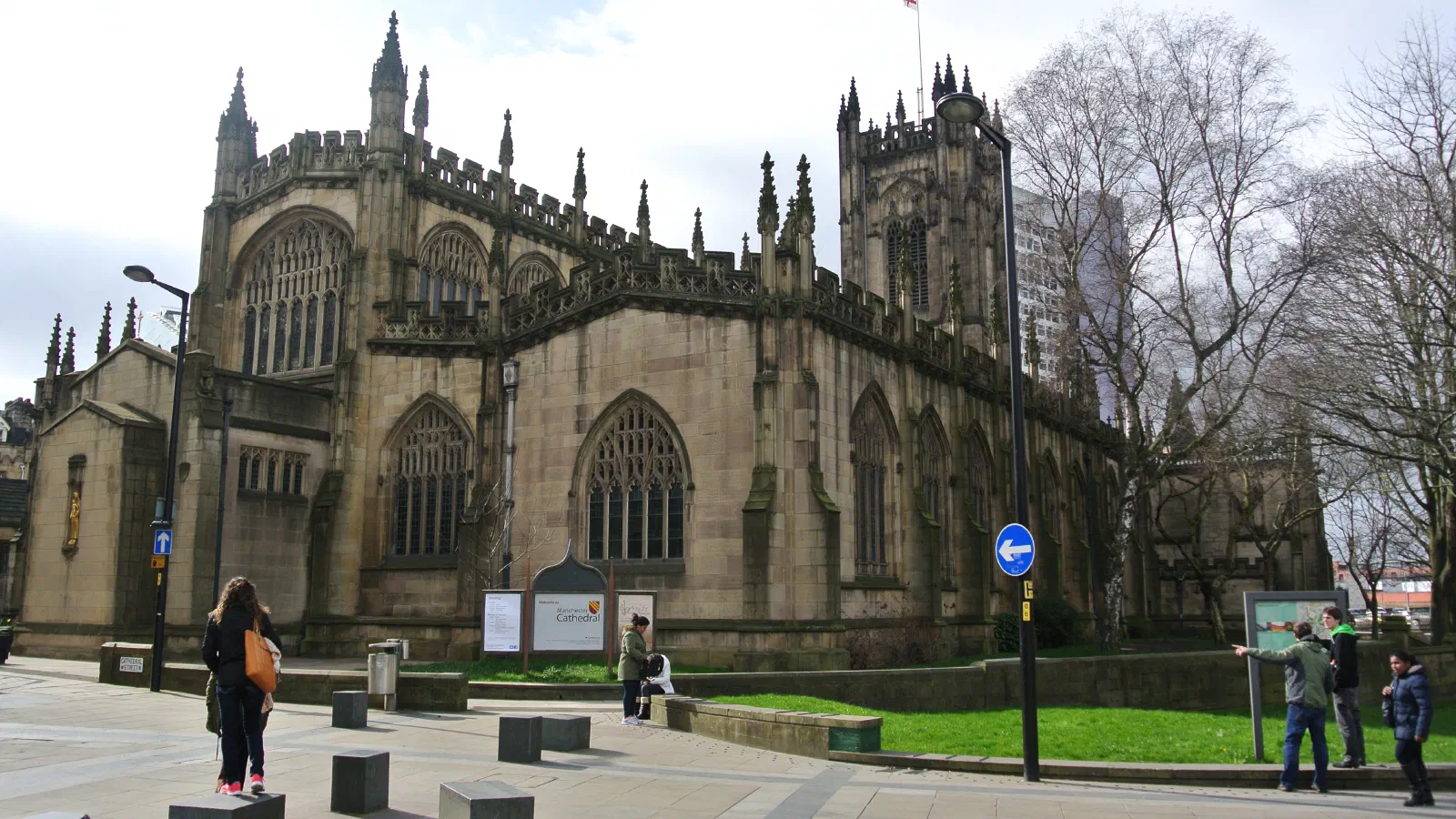
Best at any / overcast
Manchester Cathedral
Medieval Quarter · ManchesterSome gear links on this page are affiliate links — if you buy through them we may earn a small commission at no extra cost to you. See our affiliate disclosure.
What is Manchester Cathedral?
Manchester Cathedral, formally the Cathedral and Collegiate Church of St Mary, St Denys and St George, is a medieval church dating from the early 15th century. It stands at the heart of the city’s Medieval Quarter, overlooking the River Irwell and surrounded by modern development that makes its Gothic silhouette all the more striking.
The cathedral is known for its exceptionally wide nave (the widest of any medieval church in England), its elaborate misericord carvings — one of the finest collections in the country — and its striking stained glass, including the Fire Window by Tony Hollaway commemorating the 1940 Christmas Blitz.
The exterior is built from red sandstone, which weathers to a dark, characterful finish. Inside, the perpendicular Gothic vaulting, carved wooden choir stalls, and medieval angel roof create an atmosphere of quiet grandeur.
Why Shoot Here?
- Gothic Architecture: The perpendicular Gothic tracery of the windows, the flying buttresses, and the ornate tower are excellent subjects for exterior architectural photography.
- Interior Light: The stained glass windows cast coloured light across the stone interior — particularly effective in the morning when east-facing windows are lit.
- Misericords and Woodwork: The choir stall carvings are intricate and quirky — a macro or close-up lens captures the medieval craftsmanship.
- The Fire Window: Tony Hollaway’s modern stained glass is a striking contrast to the medieval stonework and makes for a powerful standalone subject.
- Exterior Contrasts: The cathedral is flanked by glass towers and the modern Cathedral Visitor Centre, creating dramatic old-meets-new compositions.
Getting There
Victoria and Exchange Square Metrolink stops are both about three minutes away, and Victoria is also the nearest rail station. NCP Manchester Arndale is the nearest car park at roughly £8–12 per day. The cathedral stands at the heart of the medieval quarter, overlooking the River Irwell with modern development on every side — which is itself the reason the Gothic silhouette reads so hard.
Entry is free with donations welcome, but this is an active place of worship rather than a museum: services run at set times and interior photography is restricted around them. Check the cathedral calendar before travelling, and aim for a weekday mid-morning between services. Chetham’s Library and the Hanging Bridge are both next door, and Greengate is five minutes across the water — the medieval quarter to Spinningfields walk starts here.
Photography FAQ
Can you take photos inside Manchester Cathedral?
Handheld photography is generally welcomed outside of services, and the cathedral is used to visitors with cameras. Never photograph during a service, a wedding or a funeral, and be aware that private events can close areas at short notice. Tripods should be cleared with the vergers rather than assumed — the nave is a working space, not an empty hall. Keep flash off: it is intrusive in a quiet building and does nothing useful for stained glass anyway.
What is the best time to photograph the interior?
From 10:00 on a weekday, between services. The east-facing stained glass — including Tony Hollaway’s Fire Window, commemorating the 1940 Christmas Blitz — takes direct morning light that activates the colour and throws tinted pools across the stone floor. It is also the quietest window, before the lunchtime tour groups arrive, which matters when the shot you want is a clean sightline down the nave.
Why shoot the exterior on a dull day?
Because of the sandstone. The red sandstone weathers unevenly, and in direct sun it darkens, goes patchy and throws half the carved tracery into unreadable shadow. Overcast light makes the colour richer and more even and lets the window tracery and the tower detail read across the whole facade. The exception is blue hour, when the ground-level uplighting works against a deep sky — shoot from the Hanging Ditch pedestrian area or from across the Irwell in Greengate, and keep the Visitor Centre’s glass in frame for the old-and-new contrast.
What should I photograph inside?
Three things. The nave from the west end at 16–24mm — it is the widest of any medieval church in England, and a wide lens is the only way to convey that along with the bay rhythm and the Fire Window at the far end. The Fire Window itself at 70–200mm from the nave floor, filling the frame so the fragmented abstract glass loses its architectural surround. And the misericords under the choir stall seats, among the finest and most eccentric in the country — wrestlers, green men, a fox preaching to geese.
What lens do I need for the misericords?
A fast prime, 35mm at f/2.8–f/4, or a short telephoto if you can get the working distance. They are carved into the undersides of hinged seats in low, warm choir lighting, so you need speed rather than reach, and a shallow depth of field isolates a single figure against blurred wood grain. This is close-up work in poor light in a confined space — the hardest technical shot in the building, and the most rewarding.
Best Times to Shoot
- Morning (from 10:00) — The east-facing stained glass windows, including the Fire Window by Tony Hollaway, receive direct morning light that activates their colour and sends tinted pools across the stone floor. The interior is at its quietest before lunchtime tours arrive, giving you clean sightlines down the exceptionally wide nave.
- Overcast days for the exterior — Manchester Cathedral’s red sandstone darkens and becomes highly textured in direct sun; it also reflects differently depending on how weathered individual stones are. Under an overcast sky the colour becomes richer and more even, and the carved tracery on the windows and the tower reads clearly without being half in shadow.
- Blue hour for the exterior — The cathedral is subtly uplighted from ground level, and the combination of stone uplighting and deep blue sky is particularly effective when shot from the Hanging Ditch pedestrian area or from across the River Irwell in Greengate. Include the glass and steel of the Visitor Centre in the frame to contrast old and new.
- Weekday mid-mornings — Services at the cathedral run at set times that can restrict interior photography. Mid-morning on a weekday between services is the most reliable window for uninterrupted access to the nave, choir stalls, and misericords. Check the cathedral calendar before visiting.
Composition Ideas
- Wide-nave shot from the west end — Stand at the western entrance and shoot east toward the altar with a 16–24 mm lens. The nave is the widest of any medieval English church; a wide-angle lens captures the full span of the Gothic arches and the receding bay rhythm, with the Fire Window as a colourful focal point at the far end.
- Cathedral tower through Chetham’s archway — Walk around to Chetham’s Library on the north side and find an archway or gate that frames the cathedral tower beyond. The medieval stonework of Chetham’s in the foreground and the cathedral tower above create a layered medieval composition using a 35–70 mm lens.
- Fire Window close-up — Use a 70–200 mm telephoto from the nave floor to fill the frame with Tony Hollaway’s 1997 stained glass commemorating the Christmas Blitz. The abstract fragmented glass is a striking contrast to the Gothic architectural surround, and the telephoto compression removes distracting vertical context.
- Misericord carvings with 85 mm macro or short telephoto — The misericord carvings under the choir stall seats are among the finest and most eccentric in England. A fast prime — the Sony FE 35mm f/1.8 , Canon RF 35mm f/1.8 Macro IS STM , NIKKOR Z 35mm f/1.8 S , or the Fujifilm XF 23mm f/2 R WR on Fujifilm X — at f/2.8–f/4, shot in the available choir lighting, isolates individual carved figures — wrestlers, green men, fox-preaching-to-geese — against a softly blurred wood-grain background.
How to shoot it
Lens
A 16–35mm wide exaggerates scale and verticals; a 24–70mm keeps proportions natural. A tilt-shift tames converging lines.
Settings
f/8–f/11 for front-to-back sharpness, ISO 100, and meter for the highlights so detail in the stonework holds.
Composition
Hunt for symmetry and repetition, keep verticals straight, and use doorways or arches to frame the subject.
Timing
Bright overcast suits it best — soft, even light with no harsh shadows — so it works at almost any time of day.
More in Medieval Quarter
See the area →Nearby spots
Any / overcast Any / overcast