 Golden hour
Best at golden hour
Castlefield Viaduct
Castlefield · ManchesterSome gear links on this page are affiliate links — if you buy through them we may earn a small commission at no extra cost to you. See our affiliate disclosure.
What is Castlefield Viaduct?
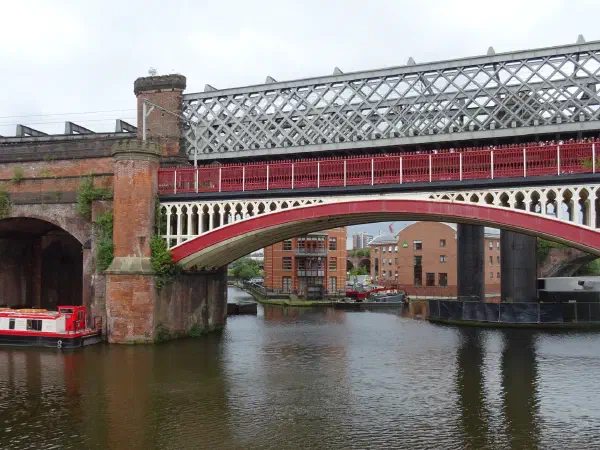
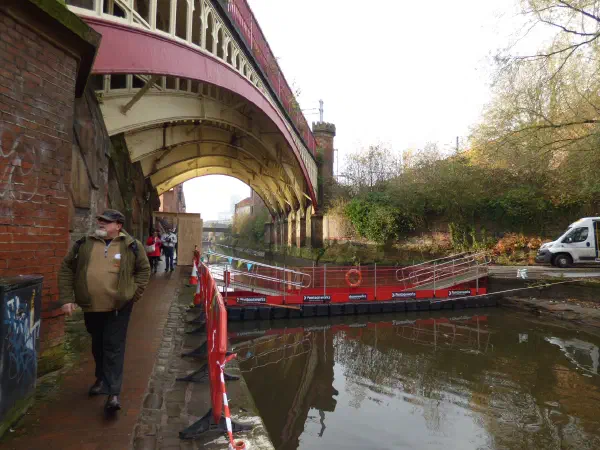
The Castlefield Viaduct is a Grade II listed Victorian steel railway viaduct located in Manchester’s historic Castlefield area. Completed in 1893 and designed by Heenan & Froude, it was built to carry heavy rail traffic into the Great Northern Warehouse. Stretching roughly 330 metres (1,080 ft) across the Castlefield Basin, the viaduct is supported by steel lattice girders and sits alongside a series of brick railway arches (en.wikipedia.org).
After closing to rail traffic in 1954, the viaduct stood unused for decades until the National Trust transformed it into a unique urban “sky park.” The temporary green space opened to the public in 2022 and features raised planters, walkways, and interpretation boards telling the story of Castlefield’s industrial heritage (nationaltrust.org.uk).
The sky park project is a pilot to explore long-term reuse, combining heritage conservation with urban greening while offering elevated views of Manchester’s canals, warehouses, and modern skyline.
Why Shoot Here?
Castlefield Viaduct provides distinctive opportunities for photographers and Instagrammers:
- Industrial heritage: Capture the intricate steel latticework against the sky, showcasing Victorian engineering detail.
- Elevated perspectives: From the viaduct’s walkway, photograph sweeping views over the Castlefield canals, viaducts, Beetham Tower, and surrounding architecture.
- Seasonal planting: The National Trust’s greenery and flowers add contrasting colour and softness to the steel structure.
- Event potential: Seasonal planting changes add fresh photographic angles throughout the year.
- Access notes: Entry is first‑come, first‑served during published opening hours; check the National Trust page if you’re planning a sunrise or sunset session.
Getting There
Deansgate–Castlefield Metrolink is a five-minute walk, and Deansgate rail station is the same. NCP Deansgate is the nearest car park at roughly £8–12 per day. The entrance is at street level on the Castlefield side; the walkway itself is step-free once you are up.
Before you travel: the viaduct is closed for maintenance works, due to reopen in autumn 2026. That is the National Trust’s own notice as of 29 September 2026 — check the National Trust page for the reopening date. The canal basin and towpaths below are unaffected and open at all hours, so the Castlefield canals remain the reliable shoot in this corner of the city.
When it is open, the sky park is free but ticketed, on limited days and closing in the late afternoon. That has two consequences for photographers: you cannot shoot sunrise or full blue hour from the deck in winter, and slots go early on good weekends. Treat golden hour from the viaduct as a summer-only proposition.
Photography FAQ
Can you take photos on Castlefield Viaduct?
Yes — when the sky park is open (it is closed for maintenance until autumn 2026). Personal photography is welcome during opening hours, and the National Trust is used to visitors with cameras. Tripods are tolerated but the walkway is narrow and can be busy, so expect to be asked to move — a compact travel tripod causes far fewer problems than a full-size one. Commercial shoots need prior permission.
When is Castlefield Viaduct open?
It is not, currently. The National Trust has the viaduct closed for maintenance works with a reopening expected in autumn 2026 (notice checked 29 September 2026). When open it is free but ticketed, on limited days, and closes in the late afternoon — which for much of the year means the deck shuts before sunset. Always check the National Trust listing before making the trip.
What can you photograph from the viaduct?
The elevated angle is the whole point — you are looking down onto the Castlefield canals, the basin, Merchant’s Bridge and the narrowboats from a height nothing else in the area gives you. Turn round and Beetham Tower and the Deansgate Square cluster rise behind the Victorian steelwork, which is the old-versus-new frame worth queuing for.
What is the best light on the viaduct?
Late afternoon in spring and summer, when low sun warms the rust-orange girders and lights the towers behind. Overcast light is the better choice for the structure itself: flat light evens out the deep shadows between the lattice girders, so you keep detail in both the steel and the planting. Morning opening at 10am is the quietest slot.
Is it worth visiting if I have already shot the canals from below?
Yes — it is a genuinely different picture rather than the same one from higher up. From the towpath the viaduct is the subject; from the deck it becomes the frame, and the canal network below reads as a pattern you cannot see at ground level.
Further Information
- National Trust – Castlefield Viaduct — visitor info, opening times, and access guidance
- Wikipedia – Castlefield Viaduct — historical background and engineering details
- Historic England – Castlefield Viaduct Listing — Grade II listing entry with structural description
- Visit Manchester – Castlefield — broader area guide, including other nearby photography spots
Best Times to Shoot
- Morning opening (10 am, Wednesday-Sunday) — Arrive as the gates open for the quietest conditions and soft side-light that picks out the lattice steelwork against a clean sky.
- Golden hour (late afternoon) — Low sun warms the rust-orange steel girders and lights up Beetham Tower in the background, creating rich contrast between heritage structure and modern skyline.
- Spring and summer — Seasonal planting in the raised beds adds vivid colour against the industrial steel; wildflowers and grasses soften the hard geometry of the viaduct.
- Overcast days — Flat light evens out the deep shadows between girders, making it easier to capture detail in both the steelwork and the planted areas without blown highlights.
Composition Ideas
- Repeating steel patterns — Shoot along the length of the viaduct walkway using a 35-50 mm lens so the lattice girders create strong converging leading lines that draw the eye to the vanishing point.
- Elevated canal framing — Lean over the railing to frame narrowboats or Merchant’s Bridge below, using the viaduct edge as a natural border for an unusual overhead perspective.
- Old meets new juxtaposition — Position yourself so a Victorian girder fills one side of the frame while Beetham Tower or Deansgate Square rises on the other, telling Manchester’s layered story.
- Macro plant details — Bring a close-up lens like a macro lens for mirrorless to capture dew on wildflower petals or insects among the planters, with the out-of-focus steel lattice providing a distinctive bokeh backdrop.
How to shoot it
Lens
Reach for a 70–200mm to compress the towers and stack the skyline; a 24–70mm covers wider establishing frames.
Settings
Tripod, f/8–f/11, ISO 100 and exposures of 1–10s to balance lit windows against the sky.
Composition
Find a clean foreground or reflective surface, place the tallest tower off-centre on a third, and layer near and far elements.
Timing
Aim for golden hour — the hour after sunrise or before sunset — when low, warm light rakes across the scene. Today's exact window is in the panel on this page.
More in Castlefield
See the area →Nearby spots
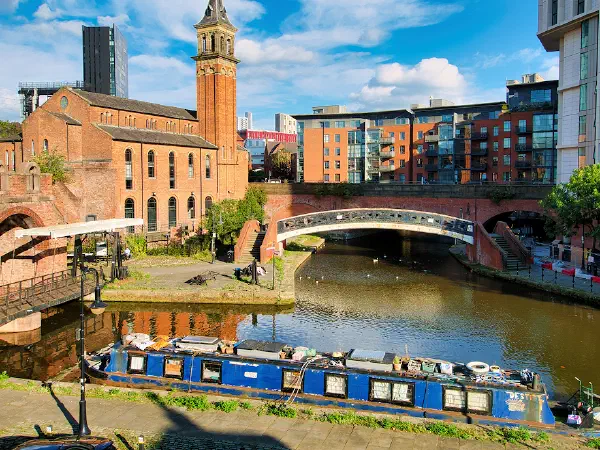
Shooting the whole area? Read the Castlefield photography guide — every spot, the light that suits it, and a route to link them.