 Night
NightBold modern structures and community spaces with a creative spirit. Colourful murals, angular housing blocks, and pockets of green give Hulme a distinct visual character. The area was almost entirely rebuilt from the 1990s onward after the demolition of the notorious deck-access flats, and the result is an eclectic mix of housing styles, public art, and open space.
Photographers will find Hulme rewarding for its colour and graphic quality. Large-scale murals appear on gable ends and underpasses, offering strong compositions with minimal effort. The Birley Fields campus and Hulme Park introduce more contemporary architecture and landscaping, while the remaining stretches of older terraces add grit and contrast.
Expect subjects in street art, architectural detail, and community-focused documentary work. The area is less visited by photographers than the Northern Quarter or Ancoats, which means fresher material and fewer competing angles. It works well as a half-day walk, looping through the park and residential streets before heading towards the Oxford Road Corridor.
Start with these three
Hulme is spread out compared with the city-centre areas, so treat this as a half-day loop rather than a quick circuit.
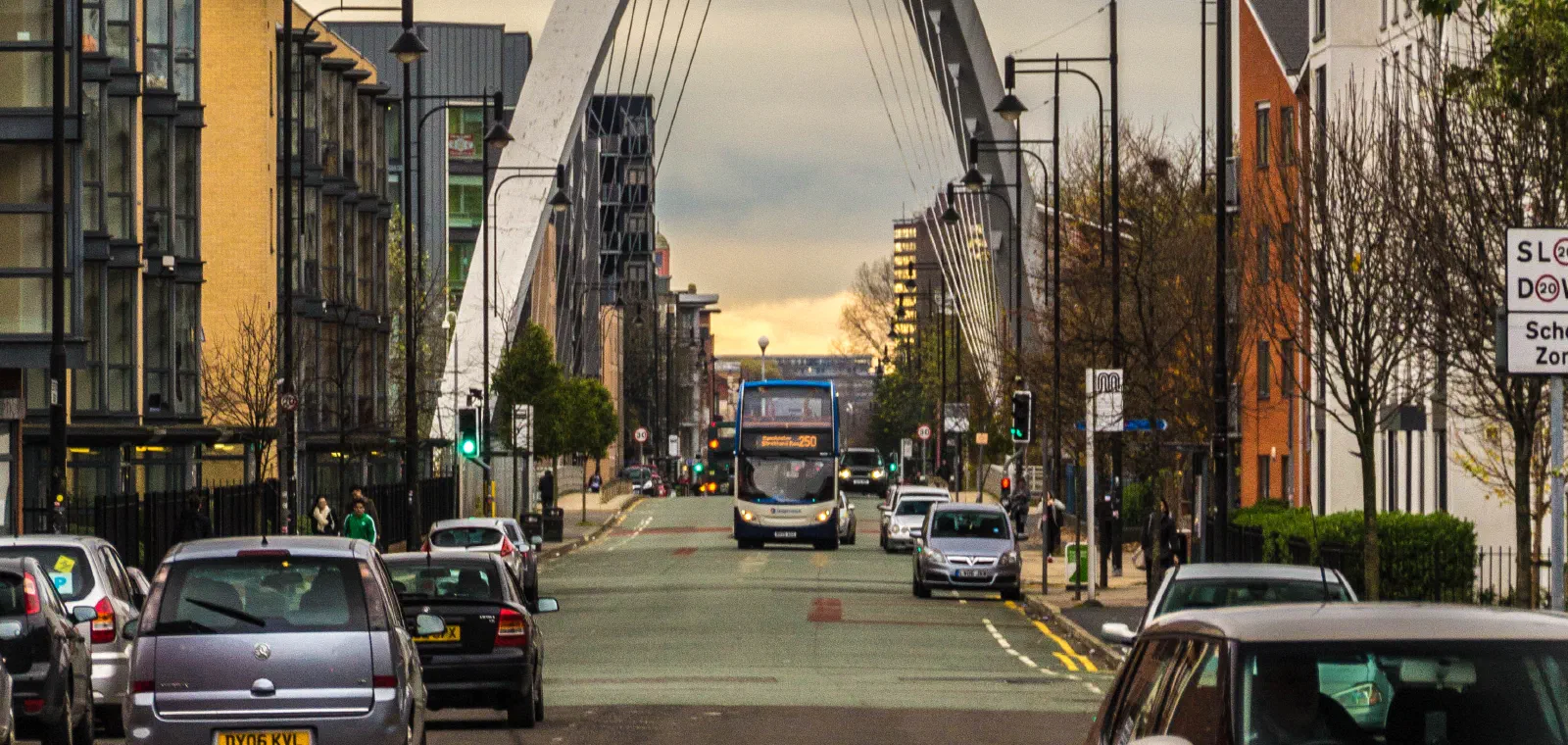
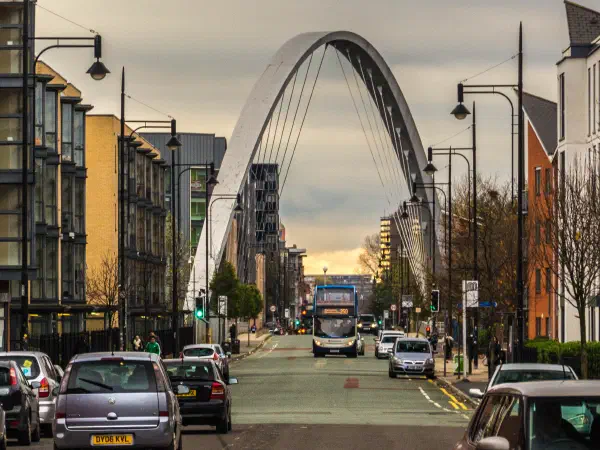
- Hulme Arch Bridge — a single white arch, taut cables and a straight deck: essentially a ready-made graphic composition, and the area’s signature structure. It is lit after dark, and the constant traffic on Princess Road below feeds long exposures with red and white light trails. That is the shot worth planning around.
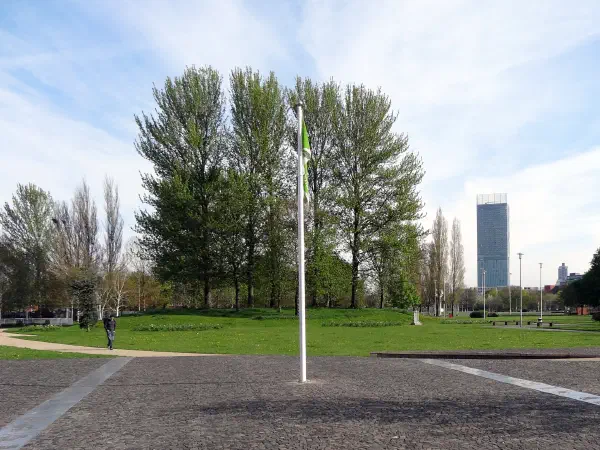
- Hulme Park — geometric pathways and modern landscaping rather than Victorian parkland, which gives you urban-landscape material most parks do not. From several points you get a clear line to the city-centre skyline, Beetham Tower included, framed by greenery.
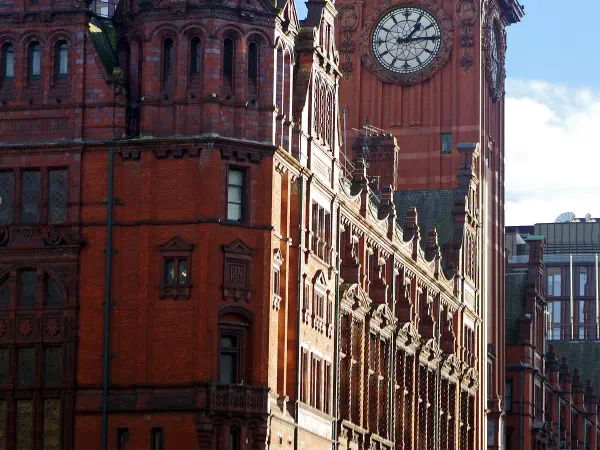
- Kimpton Clocktower Hotel (The Refuge) — Victorian Gothic on the outside with a clock tower visible from across the city, and a glass-roofed Winter Garden with indoor trees inside. A completely different register from the other two.
Best light in Hulme
The Arch is a night subject — go at blue hour so the sky still has colour behind the white arch, set up for a thirty-second exposure and let the Princess Road traffic draw the lines. It is one of the most dependable light-trail locations in Manchester because the traffic never really stops.
Hulme Park is a golden-hour subject: low sun across the open landscaping, with the skyline behind. The murals on gable ends and underpasses around the residential streets read best under flat overcast light, which keeps the colour saturated.
The area is much less photographed than the Northern Quarter or Ancoats, which means fresher material and fewer angles that have already been done to death.
Getting there and access
Cornbrook Metrolink is five minutes from the Arch and eight from the park; Oxford Road rail station is two minutes from the Refuge. Flat throughout.
The park, streets and the ground around the Arch are public. The Arch spans a busy dual carriageway — shoot from the footways and the park side, never from the carriageway itself, and give yourself room if you are working with a tripod in the dark. The Refuge is a hotel and bar: the Winter Garden is accessible to customers, so buy a drink and be discreet.
Pair it with
- Manchester night photography: best locations — the Arch is one of the best light-trail spots on that list.
- Best tripod for blue hour in Manchester — thirty-second exposures beside a dual carriageway are exactly the case that separates tripods.
- Top 10 hidden photography spots in Manchester — Hulme is under-shot, which is the point.
- Neighbouring areas: the Oxford Road corridor is the natural continuation east.
In this area